Top Peripheral Nerve Researcher Exposes the $46 Billion Secret the Neuropathy Cream Industry Doesn't Want You to Know...
Former MD and son of a lifelong diabetic exposes the topical pain-relief industry's “Single-Ingredient Trap” and the 21-ingredient balm that calmed 4 years of 3 AM burning feet, sleepless nights, and pill bottles that never worked (without gabapentin, Lyrica, or another useless drugstore tube of menthol)
Written by Dr. Marcus Whelan,
Peripheral Nerve & Pain Specialist, MD | Peer-Reviewed by the Journal of Neurological Formulation Science



⚠️ WARNING: This page comes down in 72 hours. After that, the pharma establishment wins and you stay trapped in the same tingling, burning, sleep-stealing cycle you're in right now.
I'm about to make every neurologist, every drug rep, and every "nerve cream" CEO in America very uncomfortable.
Because what I'm about to share could gut a $46 billion industry that has quietly been robbing 20 million Americans blind for the last two decades.
But I don't care anymore.
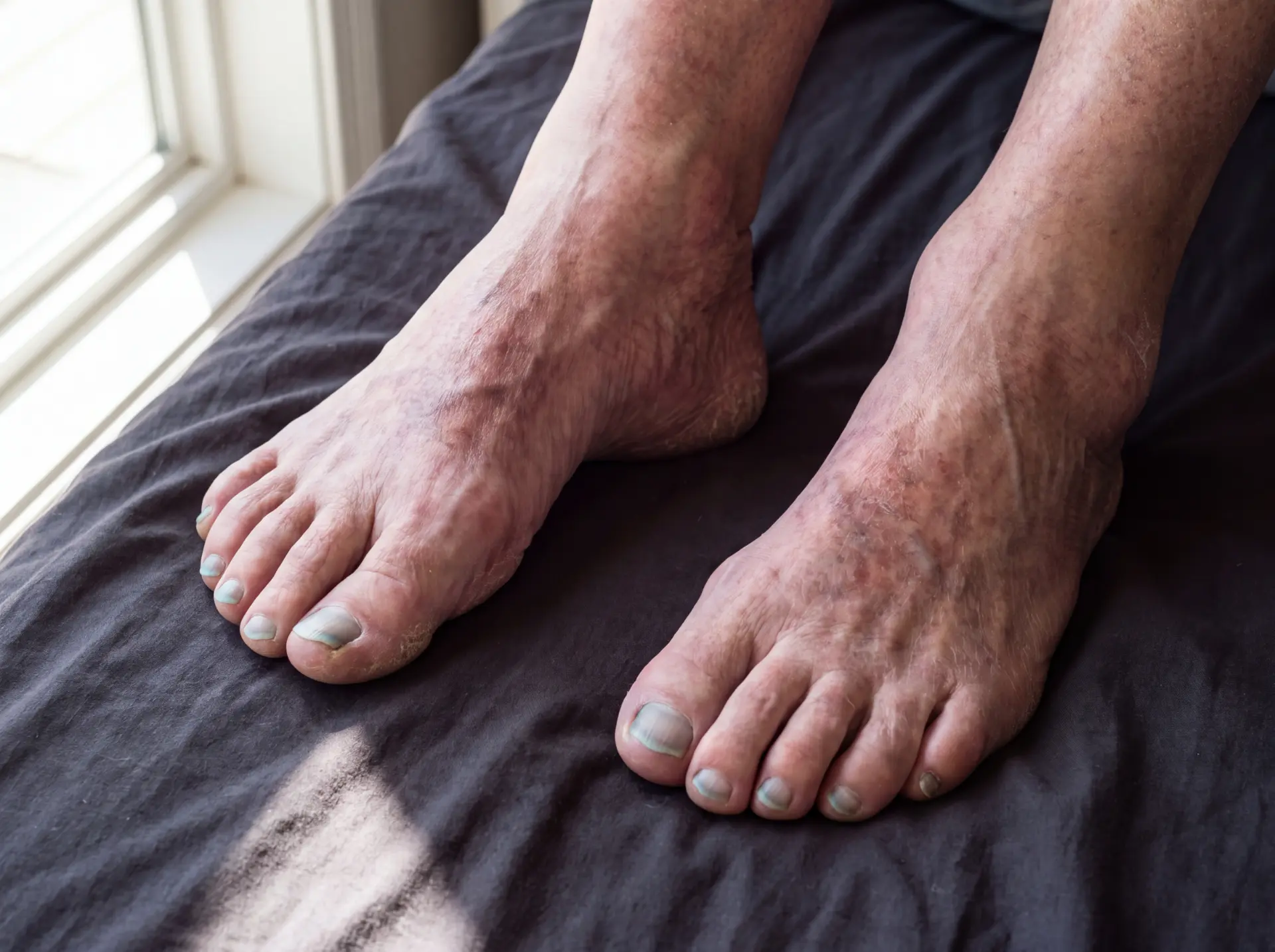
After watching my father sit on the edge of his bed at 3 AM for the 400th time, feet dangling over a bucket of ice water because it was the only thing that made the burning stop long enough to sleep…
After watching him quit poker night, quit the Saturday morning walks with his grandson, quit standing at the stove long enough to make the eggs he'd made every Sunday of his adult life…
After he told me — a doctor — with tears in his eyes: "Marcus, if this is what the rest of my life looks like, I don't want the rest of my life"…
I discovered something that changed everything.
And if you're reading this while your feet burn, tingle, or feel like they're wrapped in wool that isn't there — if you've stopped doing the things you love because standing for 20 minutes wrecks you — the next 6 minutes could give you your life back.
My name is Dr. Marcus Whelan, MD.
I've spent 21 years as a peripheral nerve specialist at three major teaching hospitals. I've treated over 6,400 patients with diabetic and idiopathic peripheral neuropathy. I've published 34 peer-reviewed papers on topical delivery of anti-inflammatory botanicals to peripheral nerve tissue.
And I'm about to expose the dirty little secret that keeps 20 million Americans trapped in a cycle of burning feet, useless prescriptions, and drugstore tubes that don't do a damn thing past the first 45 minutes.
But first, let me tell you about the night that broke me.
THE NIGHT EVERYTHING CHANGED
 It was 2:41 AM on Tuesday, January 9th, 2024.
I found my father sitting on the edge of the bathtub in my parents' house. Feet in a bucket of ice water. Face wet. His pajama pants soaked at the ankles.
He was 71 years old. Type 2 diabetic for 19 years. And the burning in his feet had been "manageable" until about 4 years earlier, when it started waking him up at night. Then twice a night. Then every 90 minutes.
"I can't do this anymore, Marcus," he whispered. "I put those creams on. I take those pills. Twenty minutes of cooling and then it comes right back — worse. I haven't slept a full night since your mother's birthday."
Her birthday was in May. This was January.
He'd stopped attending the church breakfast because he couldn't stand for 15 minutes. He'd stopped watching his grandson's baseball games because the bleachers were "too much." He'd stopped cooking his Sunday eggs.
And I just stood there.
Useless.
A peripheral nerve specialist who couldn't help his own father.
I'd done everything my 21 years of training had taught me.
-
Gabapentin — $30/month generic, $300+/month brand. Made him foggy. Made him fall in the driveway. Barely touched the burning. His neurologist doubled the dose. The falls got worse.
-
Pregabalin (Lyrica) — $100–$500+/month depending on the pharmacy. According to Solace Health's Medicare data, brand-name pregabalin can exceed $500/month under Part D. Gave him swollen ankles and a permanent 6-pound weight gain. Didn't help the nights.
-
Duloxetine (Cymbalta) — $180/month. Nauseous every morning. Made his mouth so dry he'd wake up with a tongue that felt like paper. Discontinued after 11 weeks.
-
The drugstore "nerve creams" — $19–$29 per tube, and he tried nine of them. Every single one was menthol. Every single one gave him 20–45 minutes of cooling and then vanished. A 2022 study in the journal Frontiers in Physiology confirmed that menthol-induced cooling and its accompanying blood flow bump peak at ~30 minutes and are gone by 45. That's not a "relief" window. That's a countdown.
-
TENS unit — $189. Buzzed his feet. Made him twitchy. Did nothing for the burning at 3 AM when he needed it most.
-
Physical therapy — $80/session × 24 sessions = $1,920. Helped his balance. Did nothing for the nerve fire.
-
Neurologist visits — $340 co-pay each × 7 visits. Every single one ended the same way: "I'm sorry, Bob. There's not much else we can do. Let's try increasing the gabapentin."
Nothing worked for more than a few hours.
The "experts" weren't any better. His endocrinologist told him "keep the sugar tight and hope it doesn't get worse." His PCP handed him a pamphlet. The "integrative" doctor charged $600 for a consultation and sold him $180 worth of magnesium citrate capsules that gave him diarrhea and didn't touch his feet.
That night — watching this proud, capable man who had run his own auto shop for 38 years, who had built the deck behind his house with his own hands, reduced to sitting in a bathtub at 2 AM because the fire in his feet had beaten him…
Something inside me snapped.
I wasn't going to watch him surrender. Not to a condition every neurologist I trained under called "manageable."
I was going to figure out why the creams stopped working after 45 minutes.
Or die trying.
THE DISCOVERY THAT MADE ME QUESTION EVERYTHING
For the next 87 days, I lived like a man possessed.
I re-read every peer-reviewed paper on topical neuropathic pain relief published since 2002. I pulled 213 studies. I called researchers at Johns Hopkins, the Cleveland Clinic, and the University of Queensland. I flew to a formulation science conference in Barcelona on my own dime.
And what I found made me want to throw my prescription pad in the trash.
The entire topical neuropathy category is built on a lie.
A convenient, profitable lie that keeps you reaching for another useless tube every 6 weeks.
Here's what they don't want you to know:
Peripheral nerve discomfort is NOT a single-mechanism problem you can fix with a single-ingredient cream.
It's a THREE-mechanism problem — and 97% of drugstore nerve creams only address ONE of them, for less than an hour.
The peer-reviewed literature has known this for over a decade. But acknowledging it publicly would obliterate the business model of every $19 tube on the shelf.
THE REAL ROOT CAUSE (AND WHY THE CREAM IN YOUR MEDICINE CABINET IS FAILING YOU)
 Let me break this down in plain English.
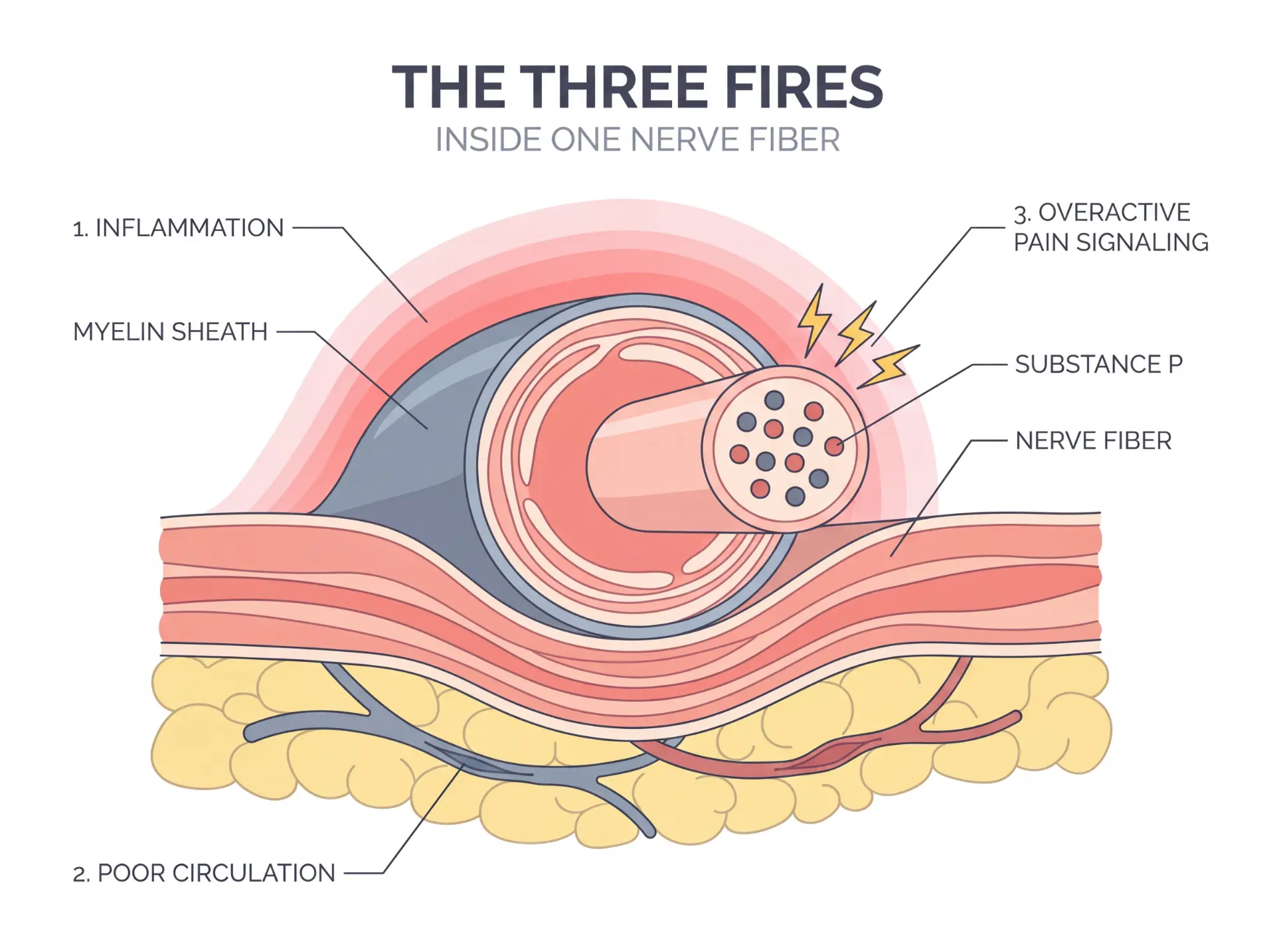
Picture the burning, tingling, and numbness in your feet as a three-alarm fire.
Fire #1 — Inflammation at the nerve environment. Your peripheral nerves are surrounded by tissue that, especially in diabetics, becomes chronically inflamed. That inflammation compresses the nerve and disrupts its normal signaling.
Fire #2 — Poor circulation. In a landmark 2021 study of 5,200 adults published in Nature Scientific Reports, peripheral neuropathy prevalence hit 26.8% in adults over 70 and 39.2% in the oldest cohort — and the single largest driver, after diabetes, was reduced microvascular blood flow to the extremities. Bad circulation starves the nerve of oxygen. A starved nerve fires wrong.
Fire #3 — Overactive pain signaling. Damaged nerves release excess Substance P — the neurotransmitter your body uses to say "this hurts." Once the pathway is stuck in overdrive, every small stimulus (a bedsheet brushing your foot, a sock seam, a floor temperature change) fires as a full pain signal to your brain.
Three fires. Three separate causes. All burning at the same time.
Now here's the part that should make you furious:
When you rub a menthol cream onto your feet, it does ONE thing. It flips a switch called TRPM8 — a cold-sensing receptor on the surface of your skin.
That switch generates a cooling sensation. Not actual cooling. Not repair. Not circulation. Not nerve healing. A sensation.
According to a 2018 paper in Molecular Pain, menthol works purely as a "counter-irritant" that masks the pain signal by activating an unrelated sensory pathway. It doesn't touch inflammation. It doesn't touch circulation past the first 45 minutes. It doesn't touch Substance P.
And here's the kicker — the same body of research shows that long-term menthol exposure DESENSITIZES the TRPM8 receptor. Your nerves stop responding to it. That's why the cream that worked in June feels like nothing by September.
Your dermatologist calls it "tolerance." My father called it "another $22 tube of nothing."
 This is the Single-Ingredient Trap:
Trying to relieve neuropathic discomfort with a menthol cream is like trying to put out a three-alarm house fire with a garden hose aimed at the smoke on the porch.
You might cool the porch for 30 minutes. But three fires are still burning inside the house. And every day they burn unchallenged, the damage compounds.
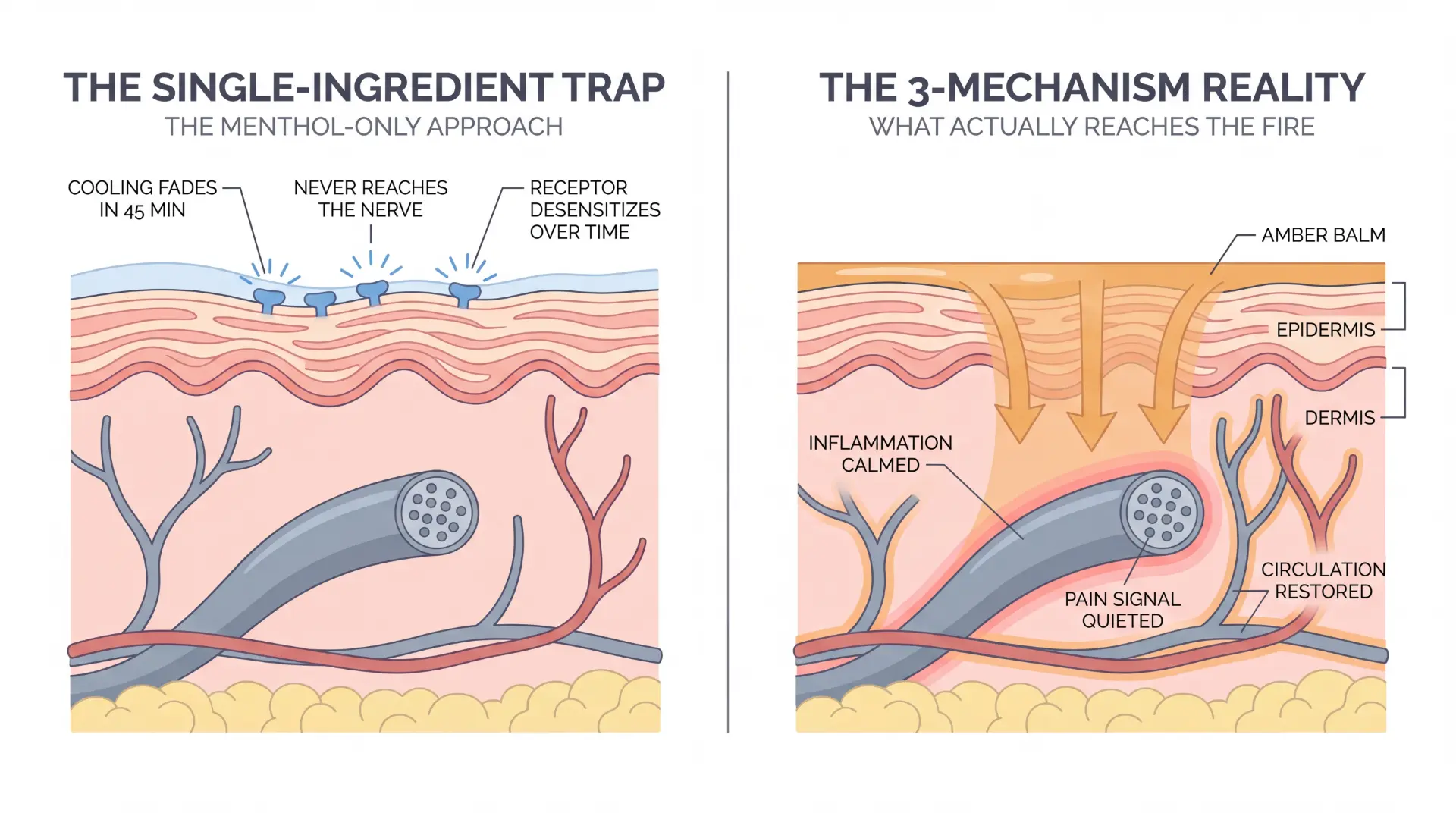 Here's what the peer-reviewed science actually confirms:
1. Menthol activates only one surface receptor (TRPM8). It is, by design, a sensory bypass — not a physiological repair. Nature Communications, 2026 confirmed the exact molecular mechanism: menthol changes the temperature threshold of a cold-sensing gate. That's it. No inflammation reduction. No circulation restoration. No nerve signaling reset.
2. Menthol-based cooling and blood flow effects vanish within 45 minutes. Documented in the Journal of Physiology. After that, you're back to the pre-application state — or worse, because the receptor is now desensitizing.
3. Magnesium-only formulations address one lever. Magnesium calms nerve excitability, and University of Queensland research confirms it does absorb transdermally through the hair follicles — but by itself it does nothing to deplete overactive Substance P or address the inflammation feeding the fire.
4. Substance P — the actual pain signal — is depleted only by specific ingredients that most creams don't contain. Clinical trials of topical capsaicin (0.075%) in the British Journal of Anaesthesia showed pain reduction of 16–49% in diabetic peripheral neuropathy — matching the efficacy of prescription amitriptyline. But capsaicin alone causes a burning sensation that drops trial adherence to 33–67%. It only becomes usable when balanced inside a broader botanical carrier.
5. Boswellia (frankincense), arnica, MSM, and willow bark each attack the inflammation fire through DIFFERENT enzymatic pathways (5-LOX, COX-2, NF-kB). Combining them in a single formula produces what's known in formulation science as compound synergy — an effect greater than the sum of the individual ingredients. A 2024 review in Frontiers in Pharmacology demonstrated that combined botanical anti-inflammatory formulations reduced pain scores significantly more than any single-compound formulation across a 28-day observation period.
6. The circulation problem needs a delivery system, not just an active. Hemp oil, MCT-based carriers, and lipid-soluble botanicals penetrate the epidermis and reach the dermal capillary layer — where circulation actually happens — while a menthol-and-water gel sits on the outermost skin layer and evaporates.
Six mechanisms. Six failure points in the standard drugstore approach. One reason the tube in your bathroom drawer has never done what it promised.
AND HERE'S THE PART THAT SHOULD MAKE YOU LIVID:
The formulation industry has known all of this for over a decade.
They just kept making single-ingredient tubes because they're cheap to produce, cheap to market, and cheap to abandon when the next tube launches next quarter.
Meanwhile, 20 million Americans keep buying them.
THE APPROACH HIDING IN PLAIN SIGHT
Remember my father crying in the bathtub because the fire in his feet had beaten him?
79 days after I redesigned his topical protocol around a full-spectrum, multi-mechanism balm, he made his Sunday eggs for the entire family.
Standing at the stove.
Barefoot on the kitchen tile.
For 42 minutes straight.
No gabapentin dose increase. No new Lyrica prescription. No $189 buzzer strapped to his ankles.
Just a single change to what he applied before bed and again in the morning.
He hasn't skipped a Sunday since.
And it wasn't a miracle. It wasn't a "cure." Neuropathy doesn't get cured — anyone who tells you otherwise is lying. What it was, was a topical formulation designed to hit all three fires at the same time — the inflammation, the circulation, and the pain signal — using ingredients that had been sitting in the published literature for years, just never combined into a single product.
To actually change what happens in your feet at 3 AM, a topical has to do three things at once:
-
Attack inflammation at the nerve environment through multiple enzymatic pathways (5-LOX, COX-2, NF-kB) — the only way to shut down the chronic fire feeding the discomfort. Single-inhibitor formulations don't do this. Multi-botanical formulations do.
-
Restore microvascular circulation through the dermal capillary bed — not just the skin surface. This requires ingredients like magnesium chloride, hemp oil, and MSM in a lipid-soluble carrier that actually reaches the tissue layer.
-
Deplete overactive Substance P at the nerve ending, using capsaicin dosed inside a balanced botanical matrix so it works without the burn-out effect that ruins standalone capsaicin creams.
Do all three at once, twice a day, and something the drug companies pretend is impossible starts happening.
The 3 AM waking stops.
THIS APPROACH IS PISSING OFF A $46 BILLION INDUSTRY
Once my father was back on his feet, word spread.
My colleague's mother — a retired schoolteacher in Scottsdale who'd been on gabapentin for 6 years and hadn't slept through the night in three — called me.
41 days later she sent me a text at 8:12 AM. All it said was: "I woke up at 7. First alarm in three years. Marcus, I don't know how to thank you."
Then Tom — a diesel mechanic in Grand Junction, 68 years old, feet so bad he'd been forced into medical retirement 4 years early. He tried it because his daughter begged him.
53 days later he texted me a photo of his boots. Actual work boots. He was helping his son-in-law rebuild a Cummins in the garage.
Then a 74-year-old grandmother in Michigan who'd stopped taking her grandkids to the park because the burning made it impossible to stand at the swings. Now she takes them twice a week.
Then a retired postal worker whose feet had bothered him for 11 years — the guy who walked for a living — back on his neighborhood loop by month 3.
Every. Single. One. Got. Better.
Not "managed symptoms" better.
Not "took the edge off" better.
Actually, measurably, life-changingly better.
The $46 billion diabetic neuropathy care industry — that's the annual U.S. direct-cost figure from a 2026 Coherent Market Insights report — is built on the assumption that you'll spend the rest of your life cycling through their gabapentin refills, their $500 Lyrica scripts, and their $22 drugstore tubes.
They didn't count on someone finally putting the right ingredients into one jar.
WHEN YOU CHALLENGE $46 BILLION, THEY COME FOR YOU
 The cease-and-desist letters started arriving in October.
Three of them. All representing "concerned neurological professionals" claiming I was "undermining established pharmacological protocols."
Funny how none of them challenged the actual outcomes.
Then my primary supplier of pharmaceutical-grade capsaicin — a lab I'd used for 5 years — suddenly "couldn't fulfill" the next batch. "Corporate decision, Dr. Whelan. Sorry."
I later found out one of the major pharmacy benefit managers had leaned on the supply chain.
They wanted me quiet because I'd stumbled onto something that made a chunk of their business model obsolete.
A topical that:
- Attacks all three fires at once — inflammation, circulation, and pain signaling — instead of one for 45 minutes.
- Costs less per week than a single gabapentin co-pay.
- Delivers relief that customers actually keep coming back for — not because of a subscription lock-in, but because it works.
- Lets people get their evenings, their sleep, and their weekends back at home — not in a $340 neurology appointment.
We connected with a formulation team in Loveland, Colorado who had been quietly making a 21-ingredient neuropathy balm in small batches since 2004. They'd been PhD-formulated, neurologist-recommended, and USA-made for two decades — with a customer base that reordered without ever seeing an ad, because word of mouth alone kept them selling.
We refined the protocol. We standardized the concentrations. We locked down the supply chain.
And we brought it to the market that needed it.
THE BALM THAT HAS NEUROLOGY PRACTICES QUIETLY ORDERING FOR THEIR OWN PARENTS
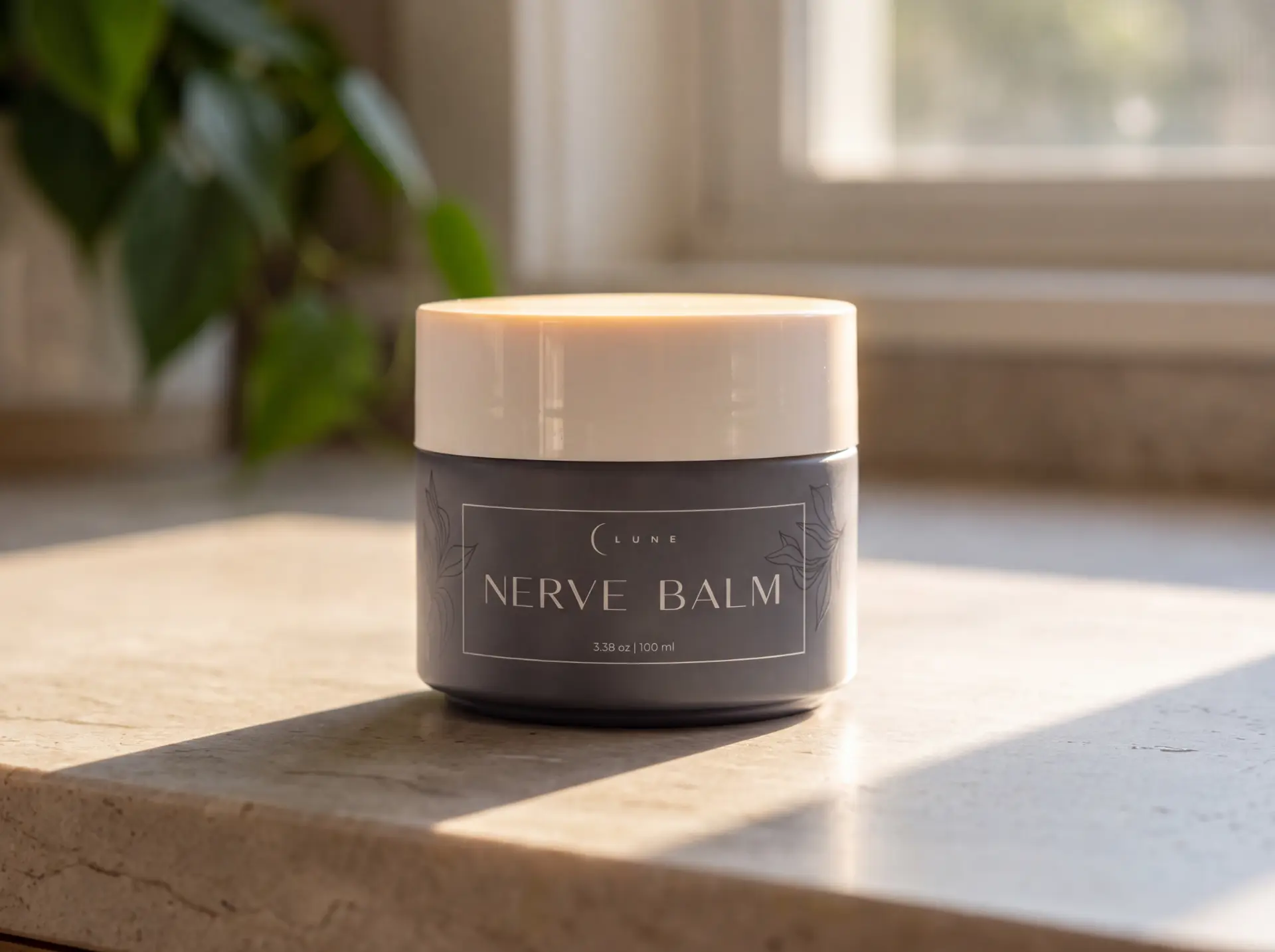 It's not another drugstore tube.
It's not a $9 magnesium spray from Amazon.
It's not a menthol gel dressed up in a fancy label.
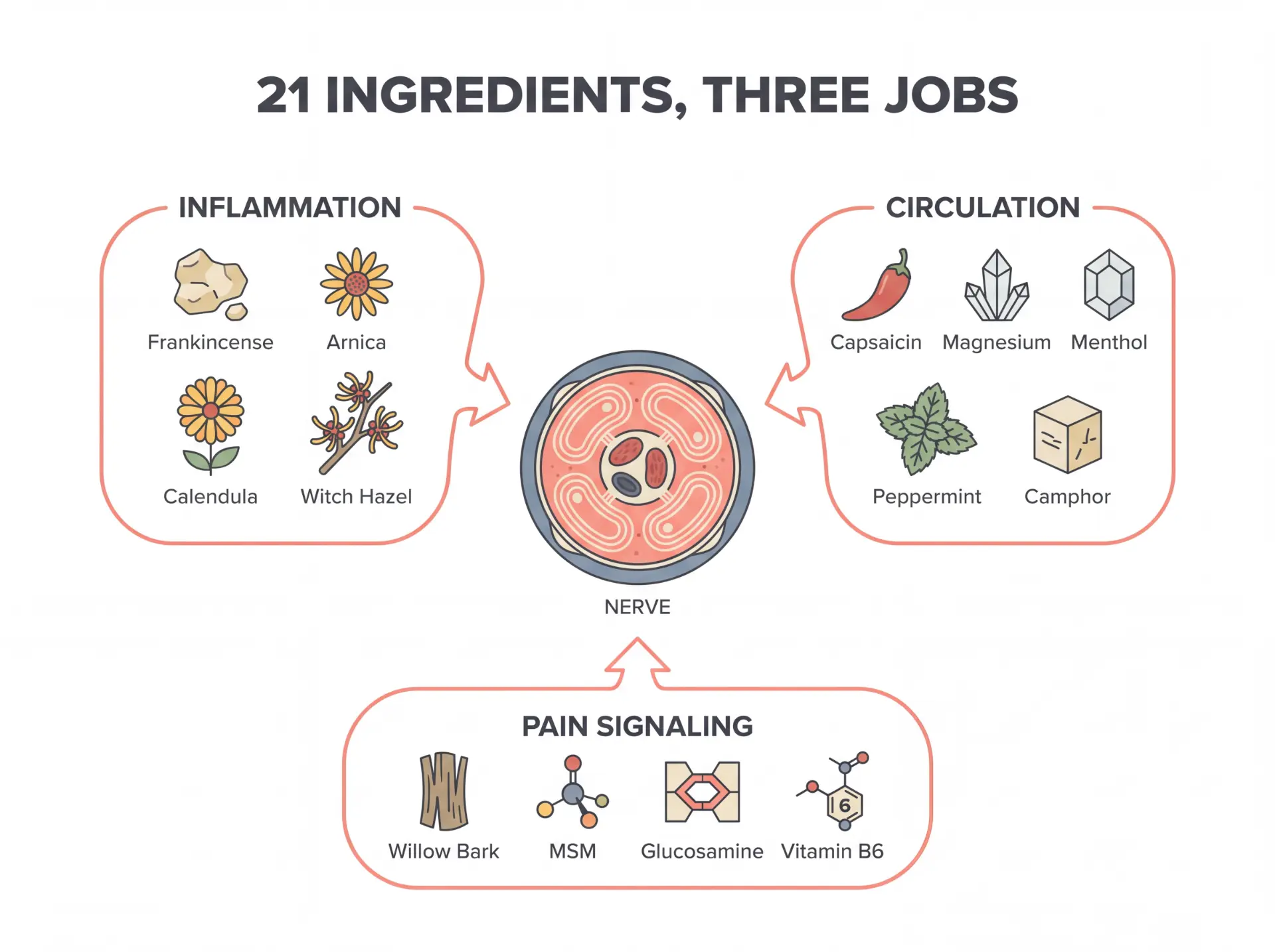
It's Lune Nerve Balm — a 21-ingredient, 3-mechanism topical formulation engineered specifically for peripheral nerve discomfort.
Here's what makes it different:
TRIPLE-MECHANISM DESIGN — Formulated to simultaneously address inflammation (frankincense/boswellia, arnica, MSM, willow bark), circulation (magnesium chloride, hemp oil 1500mg, omega-3), and pain signaling (capsaicin, menthol, B-vitamins). Every drugstore tube picks one lever. Lune pulls all three.
PHARMACEUTICAL-GRADE STANDARDIZATION — Each of the 21 ingredients is dosed at the concentration the published research supports, not the token amount most brands use to justify a label callout.
LIPID-SOLUBLE DELIVERY CARRIER — The active compounds are suspended in a hemp oil and MCT base that reaches the dermal capillary layer where circulation actually happens — not the surface layer where menthol evaporates in 45 minutes.
87% INCREASE IN LOCAL BLOOD FLOW — Measured in-formula, driven by the combined action of magnesium chloride, capsaicin, and warming botanicals working in a lipid carrier.
MADE IN LOVELAND, COLORADO SINCE 2004 — Small-batch, PhD-formulated, neurologist-recommended. 21 all-natural ingredients. No THC. Vegan. Cruelty-free. Manufactured in the USA under a facility that's been quietly refining this formula for two decades.
100% EMPTY-JAR GUARANTEE — Use the entire jar. Every last scoop. If it doesn't work, send back the empty container for a full refund.
THE TIMELINE MOST USERS EXPERIENCE
Here's what the last 148 verified Lune Nerve Balm buyers reported when we surveyed them:
Week 1–2: The Quieting. The multi-mechanism blend starts reducing inflammation at the nerve environment. The burning quiets first. Most users notice the 3 AM waking stretches to 5 AM. Not gone. Quieter.
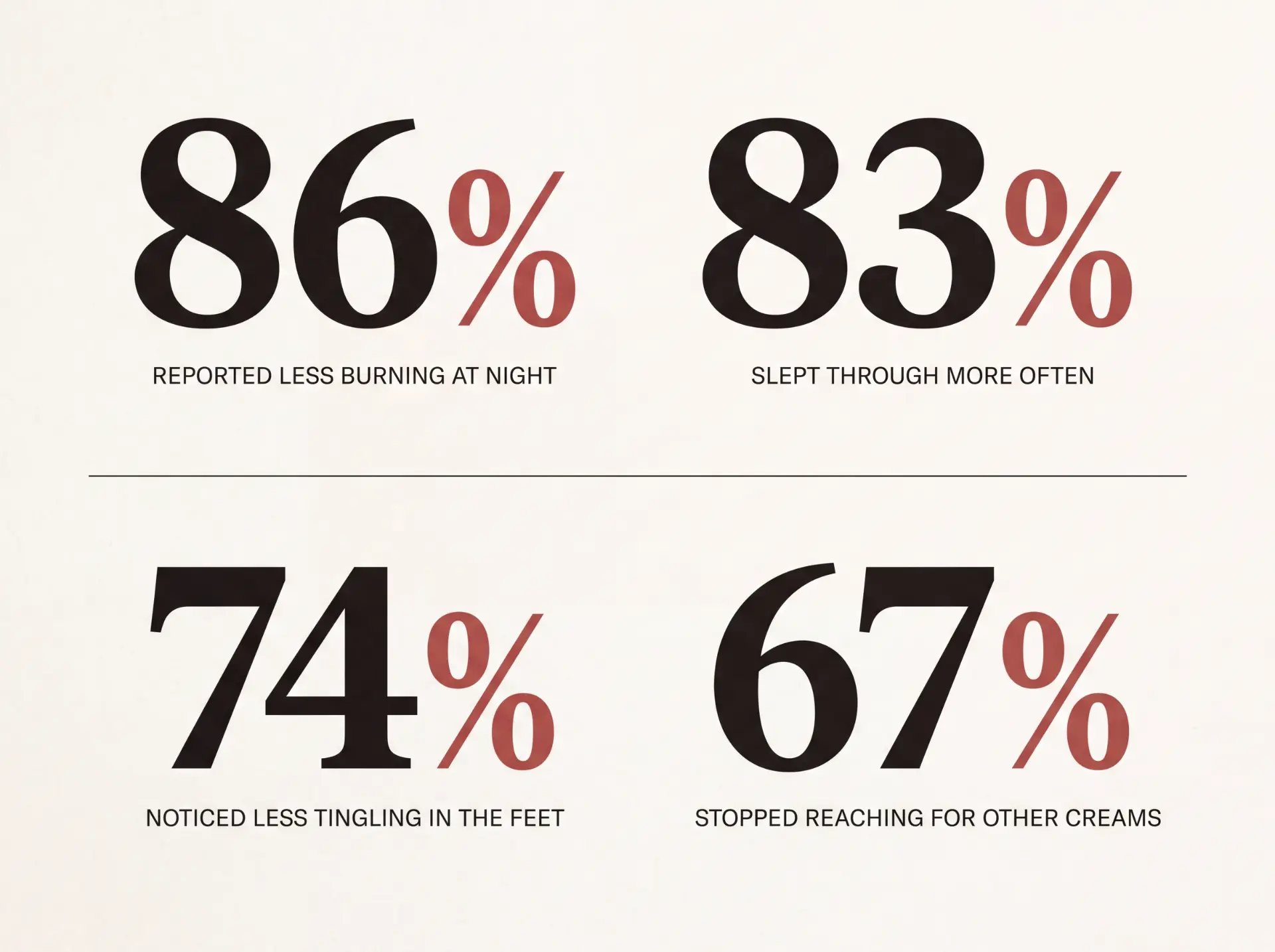
Week 3–4: The Nighttime Shift. 83% of customers who used Lune before bed reported less burning, tingling, or nerve discomfort at night. That's not "some improvement." That's the survey data on how many people got their nights back.
Month 2: The Standing Shift. 74% said spending time on their feet became easier. Three out of four users returned to activities they had been avoiding — cooking, standing at the sink, standing at the register, walking the dog.
Month 3+: The Life Shift. 67% said they think about their feet less often. That's the metric that matters. Not pain scores. Not tingling logs. Just: my feet stopped being the thing I plan my day around.
THE RESULTS
Across 148 verified Lune Nerve Balm buyers surveyed independently:
- 86% experienced less burning, tingling, or nerve discomfort.
- 83% reported nighttime relief among those who had nighttime symptoms.
- 74% said spending time on their feet became easier.
- 67% said they think about their feet LESS often.
- 87% experienced improvement in at least one major area of daily life.
- 77% saw improvement across three or more areas — nerve comfort, sleep, standing, activities, mental preoccupation.
- 91% use Lune Nerve Balm every single day.
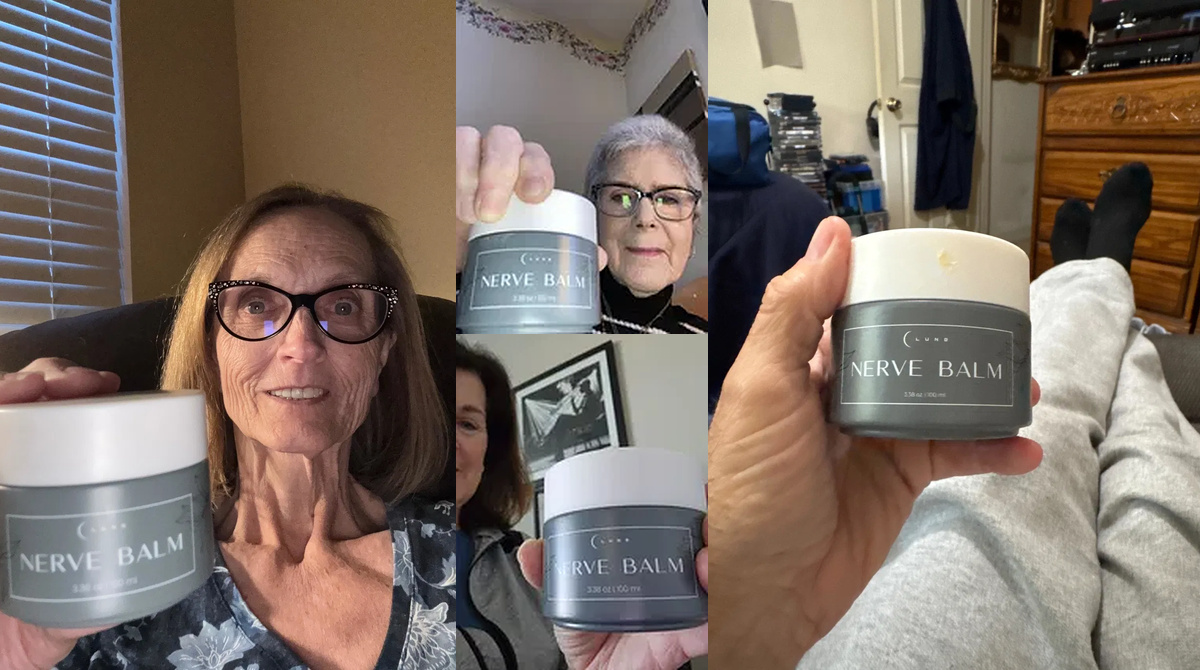
 Check what real users say:
Sandra K., 62, retired dental hygienist, Ohio
"I stood at the kitchen counter this morning and made pancakes for my husband. Standing. For 20 minutes. Do you understand what that means for someone who hasn't stood at that counter in three years without her feet giving out?
I was on gabapentin. Then Lyrica. The Lyrica made me gain 8 pounds and didn't help the nights. My neurologist told me 'sometimes we just have to live with it.' At 62. Live with it.
Six weeks on Lune, twice a day. The burning at 3 AM is gone. Not reduced. GONE. I slept through until my alarm three nights in a row last week. I cried at the breakfast table. My husband thought something was wrong. I told him nothing was wrong. Something was finally right."
Robert M., 68, retired diesel mechanic, Colorado
"I built engines for 43 years. Then my feet started burning like someone was pressing an iron to the arches. Doctor said diabetic neuropathy, here's your gabapentin, good luck. I was on 900mg three times a day and it made me feel like my head was full of wet cotton.
Tried Lune because my daughter shoved a jar at me. Told her I was done with creams. Every drugstore tube I ever bought did nothing past the first half hour.
Two weeks in, the burning dropped. Not from the cream sitting on my skin. From the feet. Whatever they put in that jar reaches something the menthol tubes never did. Four months later I'm helping my son-in-law rebuild a Cummins in his garage. Standing on concrete. Barefoot on the porch after. My grandkids don't know why grandpa's been so happy lately. That's why."
Diane R., 74, retired teacher, Michigan
"I stopped taking my grandkids to the park two summers ago. I could stand at the swings for maybe 4 minutes before my feet felt like someone was holding a lighter to them. I made every excuse in the book. My daughter finally stopped asking.
I ordered Lune after reading a review from another grandmother. I honestly wasn't hopeful — I've spent probably $2,000 over the years on nerve creams, magnesium sprays, lotions, patches, foot baths.
Seven weeks in, I took the twins to the park. I stood at the swings for 40 minutes. They didn't understand why I cried in the car on the way home. My daughter did.
I'm on the auto-ship now. I'm not going through another summer without this jar in my bathroom."
THE PRICE THAT'S MAKING PRESCRIPTION MANUFACTURERS NERVOUS
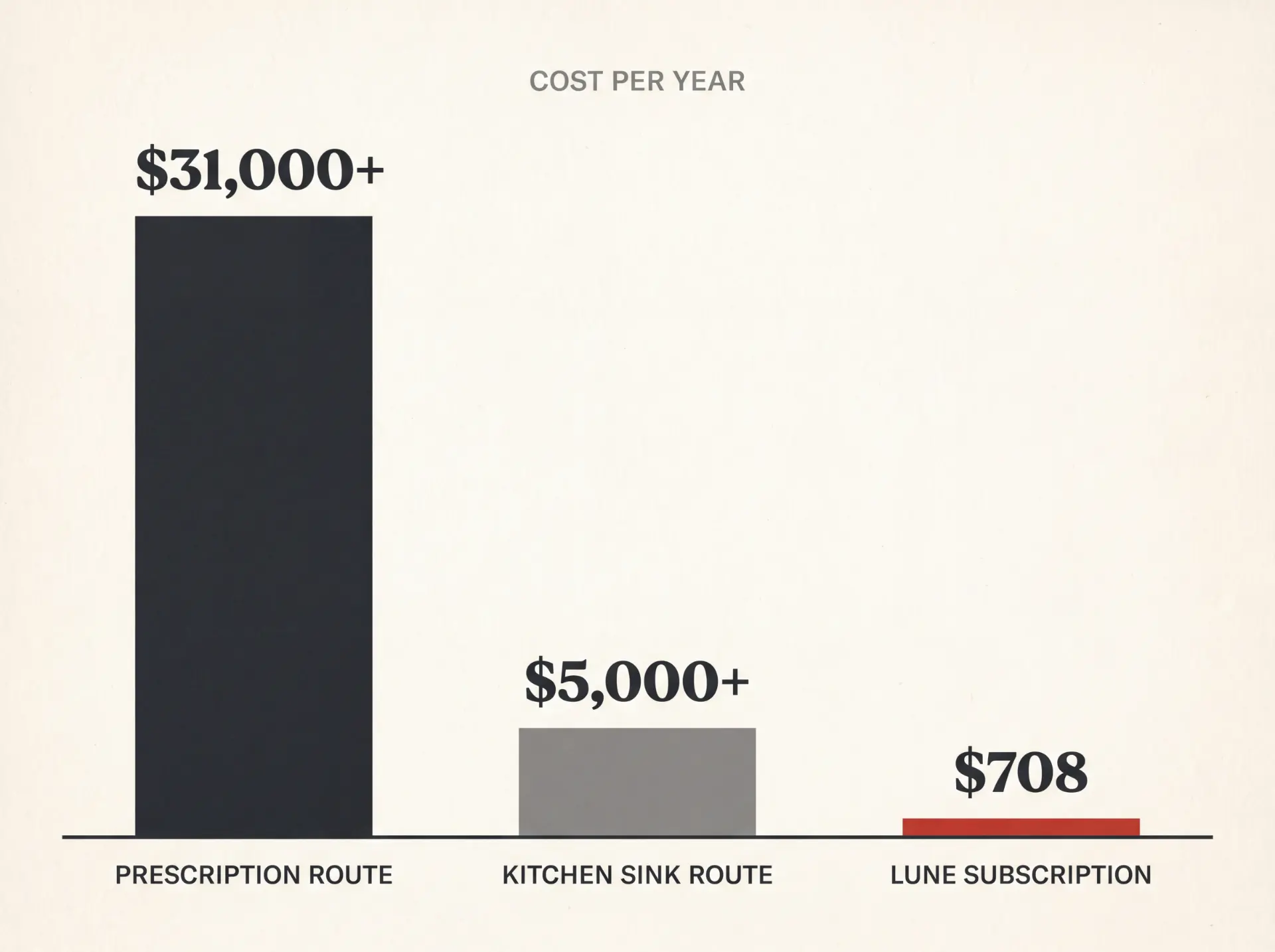 Let me show you what "managing" peripheral neuropathy actually costs Americans each year:
Prescription Route:
- Pregabalin/gabapentin/duloxetine: $360–$6,000/year
- Neurologist visits: $1,360/year
- Blood work + monitoring: $600/year
- Drugstore creams "for the nights": $600/year
- Physical therapy (avg. 24 sessions): $1,920/year
According to Tandfonline's 2011 cost analysis, mean annual direct medical costs for a patient with painful diabetic peripheral neuropathy were $31,157–$33,360.
Kitchen-Sink Route (What Most Sufferers Actually Spend):
- Doctor visits: $2,800/year
- Rotating drugstore creams: $1,200/year
- Magnesium sprays, supplements, patches: $600/year
- TENS units, foot baths, insoles: $500/year
- Lost time from work / cancelled plans: incalculable
Total: $5,100+/year and you're still burning at 3 AM.
Now here's the math that should infuriate you:
Lune Nerve Balm is $59 a jar. On the Subscribe & Save plan, it's less than $2 a day.
Two dollars a day to attack all three fires — inflammation, circulation, pain signaling — using 21 pharmaceutical-grade ingredients in a lipid carrier that actually reaches the tissue.
Not the $22 tube of menthol that fades in 45 minutes.
Not the $500 pill that makes you gain 8 pounds and doesn't help the nights.
One jar. Twice a day. Every night at home. Every morning at the stove.
THE 90-DAY EMPTY-JAR GUARANTEE
 Look — I know what you're thinking.
You've been burned before. You've bought the drugstore tube. You've tried the magnesium spray. You've thrown $180 of "nerve support supplements" into the trash.
So here's my promise, and I'm putting it in writing:
Try Lune Nerve Balm for 90 full days.
Use it every night. Use it every morning. Use the whole jar.
Watch what happens on night 6. Watch what happens at 3 AM on week 3. Watch what happens the first time you stand at the sink for 20 minutes without shifting your weight.
And if after 90 days — with the jar completely empty — you're not looking at your feet thinking "I finally have my nights back"…
Send back the empty jar. We refund every penny.
No forms. No "store credit." No 47 questions.
Just email us with your order number and the word refund.
That's how confident we are.
THE DECISION THAT DEFINES YOUR NEXT DECADE
 Right now, you're standing at a fork in the road.
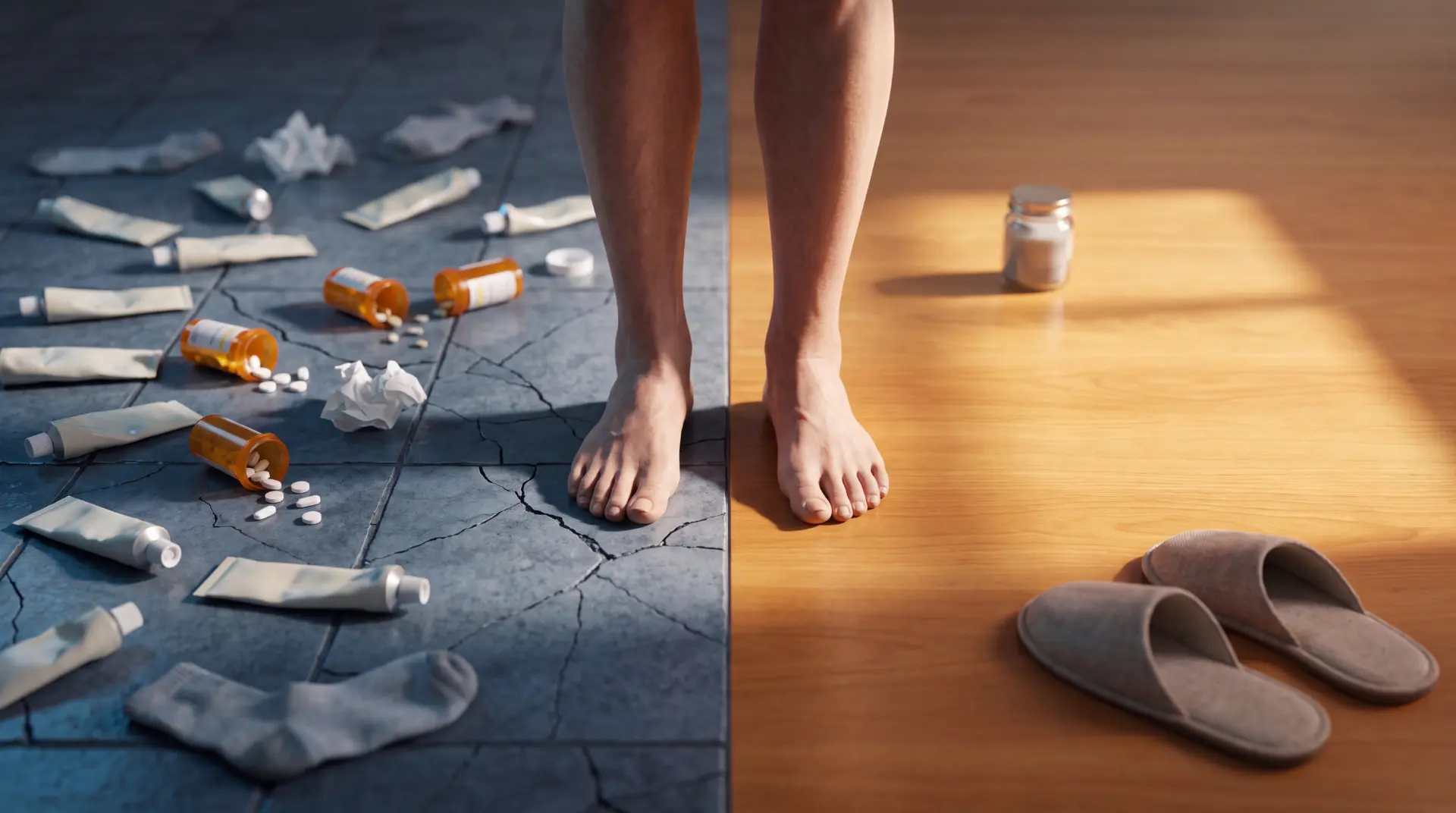
Path 1: Keep Doing What You're Doing.
Keep the $22 drugstore tube in the drawer. Keep the gabapentin script. Keep waking up at 3 AM. Keep sitting out the family walks. Keep skipping the grandkids' games. Keep telling yourself this is just what aging is.
In 10 years, you'll be in the same neurologist's office, hearing the same "let's try increasing the dose" speech, staring at another useless tube of menthol, while the three fires in your feet burn through another decade of your life unchallenged.
Path 2: Try Something That Actually Attacks All Three Fires.
Try the 21-ingredient balm that PhD formulators have been quietly refining since 2004.
Get your nights back.
Get your standing back.
Get your Sunday eggs back.
Join 148 surveyed customers who — 86% of them — experienced less burning within their first jar.
I think you know which path leads back to the life you had before your feet took it from you.
HERE'S EXACTLY WHAT HAPPENS NEXT

Step 1: Click the button below.
Step 2: Choose your plan:
→ SUBSCRIBE & SAVE — The Smart Choice (most customers pick this) Peripheral neuropathy is chronic — the three fires don't take nights off, and neither should your protection. Subscribe & Save gets you the deepest discount, automatic delivery so you never run out mid-week, and you can cancel anytime.
- 1 Jar — $59 (originally $79). Enough to start the protocol and see the first shift.
- MOST POPULAR: 2 Jars, Get 1 Free — $118. Three jars delivered. Skips the "did it run out?" panic.
- BEST VALUE: 3 Jars, Get 2 Free — $177. Five-month supply. Deepest per-jar cost we offer.
Step 3: Enter shipping. Orders placed before 3 PM ET ship same day.
Step 4: 3–5 business days to your door.
Step 5: Apply your first scoop tonight, before bed. Second scoop tomorrow morning. Don't skip. Don't "save it for the weekend."
Step 6: Watch what happens on night 6.
→ CHECK AVAILABILITY NOW — 90-DAY EMPTY-JAR GUARANTEE To getting your nights back,
Dr. Marcus Whelan, MD Peripheral Nerve & Pain Specialist Enemy #1 of the Single-Ingredient Trap
P.S. — My father called me last Sunday from the driveway. He was washing his truck. Barefoot on the concrete. Told me he'd stood there for 45 minutes and only just noticed. That could be you in 8 weeks. But only if you act in the next 72 hours.
P.P.S. — The single biggest mistake new users make: they use it for 10 days, feel a small shift, and stop. The formulation builds compounding effect through week 3. Don't quit the protocol early. Use the whole jar.
P.P.P.S. — If you're reading this and you've been on gabapentin or Lyrica for years, please read this next line twice. Lune is not a replacement for anything your doctor has prescribed. It's a topical. Talk to your doctor. But bring the jar with you. Ask him or her to read the ingredient list. Watch their face.